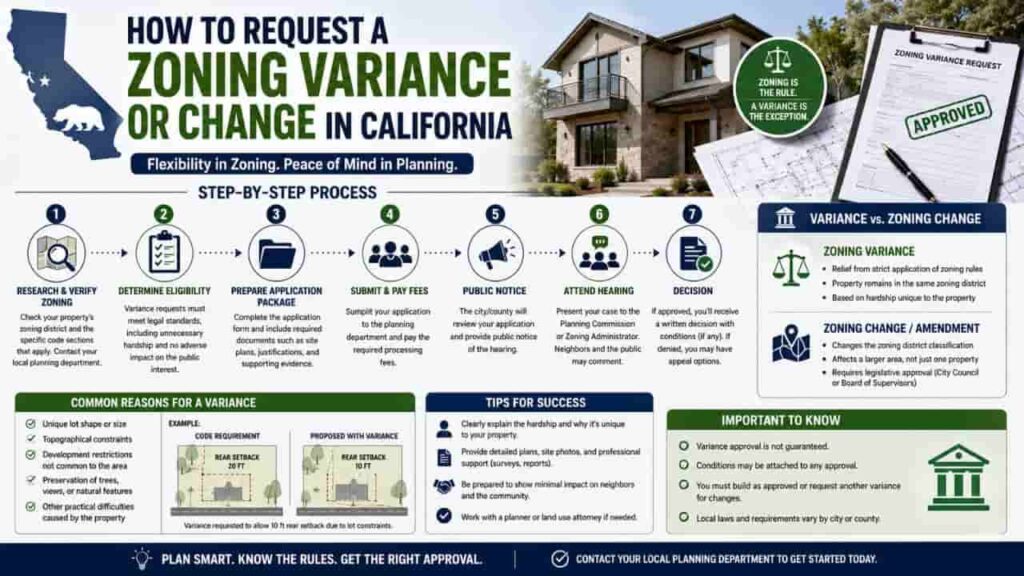
You have found the ideal piece of real estate in California, but during your due diligence, you hit a regulatory brick wall, the property’s layout or land classification does not line up with your project goals. Perhaps a strict setback rule prevents you from adding a second unit, or a residential designation blocks you from opening a neighborhood commercial office. In the real estate world, this does not have to be the end of your project. Property owners and investors across the Golden State have the legal right to request adjustments to local land use rules. However, working through the bureaucratic pipelines of a city hall or county administration building requires a precise, strategic approach. This expert guide breaks down the structural differences between a zoning variance in California and a complete rezoning amendment, mapping out the official step by step application process and public hearing workflows you must master to win municipal approval.
Variance vs Rezoning, Choosing Your Administrative Path
Before filing paperwork with your local planning commission, you must determine which legal remedy fits your exact situation. Asking for the wrong type of modification will result in an immediate denial, wasting months of planning time and thousands of dollars in application fees.
[Development Conflict] ──> Physical Hardship? ──> Request a Zoning Variance
└── Land Use Change? ──> Request a Rezoning Amendment
What is a Zoning Variance?
A variance is an administrative exception to a physical development standard found in a local ordinance. It does not change the core zoning classification of your land; instead, it gives you permission to bypass a specific structural metric, such as.
- Encroaching into a standard side or rear setback line.
- Exceeding the maximum building height cap.
- Modifying strict off street parking stall quotas.
To win a variance under California Government Code Section 65906, you must prove that a local ordinance hardship exists due to unique physical features of your parcel (such as an unusually steep slope, an odd triangular lot shape, or a sub standard parcel size) that do not apply to neighboring properties.
What is a Zoning Amendment (Rezoning)?
If you want to use the land for a purpose that is completely banned under its current code such as building a commercial storefront in a strict single family residential zone a variance cannot help you. You must submit a formal rezoning application (also known as a Zoning Map Amendment). This process changes the actual zoning classification of the parcel on the city’s master land registry map.
Comparing the Two Paths to Municipal Approval
The table below outlines the core administrative differences between securing a physical variance and completing a comprehensive land use rezoning.
| Procedural Feature | Zoning Variance Application | Rezoning Map Amendment |
| Primary Target | Bypasses physical building limits (setbacks, height caps, lot coverage). | Changes the underlying allowed land uses (e.g., Residential to Commercial). |
| Legal Threshold | Must prove a unique physical property hardship (topography, odd lot shape). | Must prove alignment with the city’s long term General Plan policies. |
| Final Approval Authority | Zoning Administrator or the local Planning Commission. | The City Council or the County Board of Supervisors. |
Step by Step Guide, Understanding the Application Process
If you need to adjust your property’s development rights, follow this official municipal workflow to prepare your files and submit them to the local building department.
Step 1. Schedule a Pre Application Consultation Meeting
Do not file paperwork blindly. Book a pre application consultation with a staff planner at your city hall or county planning counter. Present your preliminary architectural sketches to get early feedback on potential conflicts and required environmental reviews.
Step 2. Compile Property Documentation and Architectural Plans
Gather your certified site surveys, topographic elevation maps, and a complete grant deed showing your legal property description. If applying for a variance, draft a detailed “Findings of Fact” statement proving your unique physical hardship.
Step 3. Submit the Formal Application Packet and Fees
File your completed package with the local planning department. Pay the mandatory, non refundable administrative processing fees, which typically range from $2,000 to over $10,000 depending on the complexity of the municipal jurisdiction.
Step 4. Manage the Neighborhood Notification Workflow
California law requires a formal planning commission notice to be mailed to all property owners within a 300 to 500 foot radius of your parcel borders. A public notice sign must also be posted directly on your property site.
Step 5. Present Your Case at the Public Hearing
Attend the scheduled public hearing before the planning board. Present your architectural visuals, answer questions from the board, and address any feedback or concerns raised by neighboring property owners during the public comment period.
Surviving the Public Hearing and Neighborhood Review
The public hearing stage is where many real estate developers and homeowners run into unexpected roadblocks. In California, community involvement is a heavily protected legal right, and neighboring residents can voice strong opposition to your project during the public comment window.
Preparing for Community Feedback
- Proactive Outreach
Before your hearing date arrives, knock on your immediate neighbors’ doors. Show them your architectural layouts, explain how your design limits privacy issues, and resolve minor disputes quietly before they turn into public complaints at city hall. - Building a Support Record
Ask supporting neighbors to sign a simple petition or submit short letters of support to your assigned staff planner. Having a clean stack of positive community letters in your official file makes it much easier for commissioners to vote in your favor.
Key Takeaways
Securing a zoning variance in California or passing a complete zoning amendment requires combining precise engineering data with a clear understanding of local politics. While a variance demands proof of a physical land hardship, a full rezoning requires proving that your project matches the city’s long term development vision. By running clean site surveys, talking to neighbors early, and working closely with planning staff, you can successfully de risk your real estate investments and unlock your property’s true value.
FAQs
What is the legal definition of a zoning hardship in California?
A hardship means a property suffers from unique physical features like a steep cliff or an odd triangular shape that prevent the owner from utilizing the land normally.
Can I get a variance to open a commercial business in a residential zone?
No. California land use regulations prohibit using a variance to change allowed land uses. You must file a formal rezoning application instead.
How far in advance must a planning commission notice be sent out?
Under California state planning guidelines, public notices must be mailed to surrounding neighbors at least 10 days before the scheduled hearing date.
What happens if my zoning variance request is denied?
You have the legal right to file an administrative appeal to the City Council or County Board of Supervisors, provided you submit the appeal within the city’s strict 10 to 15 day window.
How long does the entire rezoning process take in California?
Because rezoning requires extensive environmental reviews under CEQA and multiple public votes, the process typically takes anywhere from 6 to 18 months to complete.
Are variance application fees refundable if my project is rejected?
No. Municipal filing fees are non refundable processing costs used to pay for staff review time, environmental routing, and public mailing distribution.
Who has the final vote on a complete zoning map amendment?
The local City Council (for properties inside city limits) or the County Board of Supervisors (for properties sitting in unincorporated zones) holds final voting authority.
What is the main difference between a variance and a conditional use permit (CUP)?
A variance adjusts physical building dimensions due to land hardships, while a CUP allows a specific business type to operate if it meets special operational rules.
Can neighbors block my zoning variance application?
Neighbors can voice complaints during the public hearing, but the planning commission makes the final decision based on objective zoning laws and physical evidence.
Do I need an attorney to request a zoning change?
While not legally required, hiring an experienced land use attorney or a professional civil engineer can drastically improve your chances of success with complex projects.