The dream of owning a piece of rural California land, whether to start an organic vineyard in Napa, run a livestock ranch in the Central Valley, or build a private family homestead surrounded by open space is a massive milestone. However, buying rural acreage is completely different from buying a standard suburban home. In the Golden State, rural and farming acres are strictly protected by California agricultural zoning laws. Many investors and homebuyers make the costly mistake of assuming that because a plot of land is large and remote, they can build whatever they want on it. They quickly run into strict farming restrictions, limitations on building multiple homes, and environmental protection laws. This guide will break down what an A 1 zoning designation means, look at strict county land use rules, and show you how to leverage massive state level property tax incentives to keep your rural land affordable.
What is A 1 Agricultural Zoning in California?
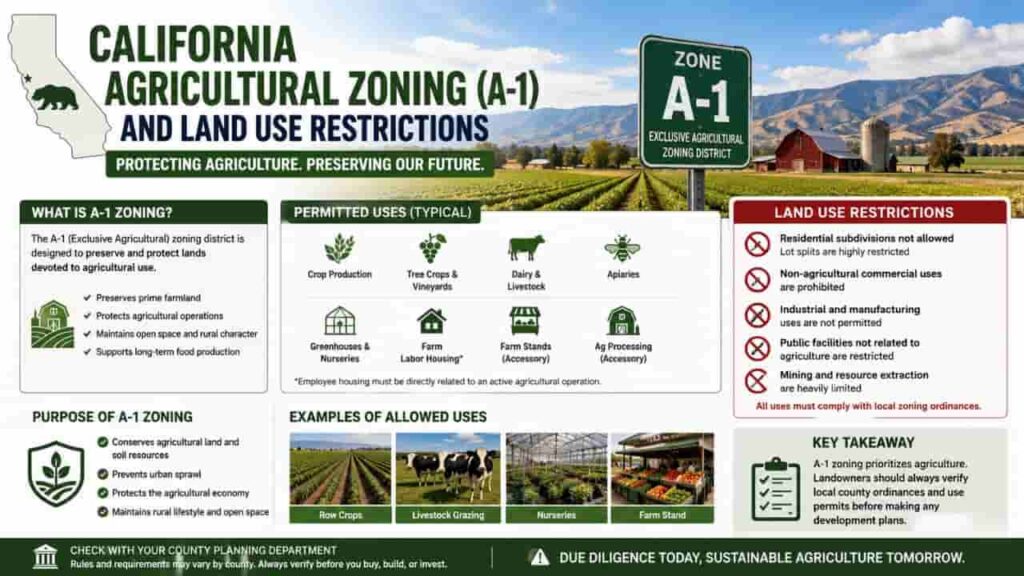
The A 1 classification stands for Limited Agricultural Zone (though some counties call it General Agriculture). It is a zoning designation designed by local planning departments to preserve fertile soils, protect the state’s multi billion dollar farming economy, and prevent urban sprawl from eating up pristine open space.
State Conservation Policy ──> Williamson Act Contract ──> County A-1 Zoning ──> Active Farm Protection
While residential zones focus on housing density, agricultural zones prioritize the land’s productive output. In an A 1 zone, commercial farming, livestock grazing, and crop cultivation are permitted “by right,” while non agricultural developments face strict regulatory hurdles.
Understanding A 1 Land Use Permissions and Restrictions
Before investing capital into an A 1 parcel, you must understand what activities are legally allowed and what structures will trigger an automatic code violation from the county.
The table below breaks down typical land use allowances inside standard California A 1 zones.
| Permitted By Right | Allowed with a CUP (Conditional Use Permit) | Strictly Restricted / Prohibited |
|---|---|---|
| Commercial crop cultivation | Commercial equestrian centers | High density housing tracts |
| Livestock grazing & breeding | Wineries & public tasting rooms | Heavy industrial manufacturing |
| One primary single family home | Agricultural homestays / B&Bs | High traffic retail storefronts |
| Small roadside farm stands | Large solar energy arrays | Multi unit apartment complexes |
Minimum Lot Size Restrictions
One of the most critical aspects of rural zones is the mandatory minimum lot size requirement. To prevent developers from buying massive farms and splitting them into tiny suburban housing tracts, A 1 zones carry high minimum acreage requirements. Depending on the specific county (such as Fresno, Kern, or Sonoma), an A 1 zone might require a minimum lot size of 5, 10, 20, or even 40 acres just to secure a building permit for a single primary home.
Can You Build a House on A 1 Agricultural Land?
Yes, but with strict limitations. Local planning commissions generally allow the owner of an A 1 parcel to construct one primary single family residential dwelling. This home is legally considered an accessory use to support the person managing or farming the land.
Rules for Guest Houses and Employee Housing
If you want to build a second home, a worker’s cottage, or a guest house, you must follow strict rules.
- Farmworker Housing
Under the California Employee Housing Act, local jurisdictions must allow housing for agricultural workers, but you must prove the occupants are actively employed on site. - Accessory Dwelling Units (ADUs)
Recent state level housing laws allow homeowners to add an ADU on residential properties, but in rural A 1 zones, local counties often impose strict structural limits regarding water well capacity, septic tank sizes, and wildfire defensible space clearings.
The Williamson Act, High Value Tax Relief for Landowners
You cannot discuss ag land preservation in California without explaining the landmark Williamson Act (officially known as the California Land Conservation Act of 1965). The Williamson Act is a state supported program that offers massive property tax incentives to rural landowners who agree to preserve their land for agricultural or open space uses.
Landowner Signs 10 Year Rolling Contract ──> Land Assessed by Farming Value (Not Market Value) ──> Tax Bill Drops 20% to 75%
How the Williamson Act Works
- The Contract
The landowner enters into a voluntary, legally binding contract with the local county government. The owner promises not to develop the land for non agricultural uses for a rolling minimum term of 10 years. - The Tax Relief
Instead of assessing your property taxes based on the high speculative market value of the real estate, the county assessor calculates your tax bill based on the actual farming income generated by the land. This can drop your annual property tax bill by 20% to 75%, saving landowners thousands of dollars every year.
How to Exit a Williamson Act Contract
If you decide you want to develop the land into a housing subdivision or commercial center, you cannot simply cancel the contract overnight. You must file a formal Notice of Non Renewal. The contract will then take 9 full years to slowly wind down and expire, during which time your property taxes will incrementally rise back to standard market rates.
Step by Step Guide, Conducting Due Diligence on California Ag Land
If you are researching an agricultural parcel for purchase or development, follow this professional step by step workflow to ensure you don’t run into legal or environmental roadblocks.
Step 1. Verify the Assessor’s Parcel Number (APN)
Locate the unique APN on the property’s current tax bill or look it up by address via the local county assessor’s web directory.
Step 2. Check the Active Williamson Act Status
Review the property’s preliminary title report or tax assessment history. Look closely to see if the parcel is listed under an active Williamson Act contract, as this will heavily restrict your immediate development plans.
Step 3. Verify Water Rights and Septic Suitability
Unlike urban properties, rural land relies on groundwater wells and private septic systems. Verify your legal water rights with the local water district and order a professional soil percolation (perc) test to ensure the ground can support a wastewater septic layout.
Step 4. Review Local County Zoning Ordinances
Open the specific county’s municipal planning code database. Cross reference your A 1 code to check the exact minimum acreage sizes required to build a permanent home or structure.
Step 5 Consult with the County Agricultural Commissioner
Schedule a pre application meeting with the local county building counter. Confirm that your proposed crop use, livestock choices, or barn construction plans comply with regional environmental protections and right to farm ordinances.
Key Takeaways
Understanding California agricultural zoning laws requires looking past the physical size of a piece of land to understand its underlying legal restrictions. While A 1 zoning protects beautiful open space and offers incredible tax relief through the Williamson Act, it demands strict compliance regarding building sizes, housing density, and land use. By completing thorough due diligence on water rights, lot minimums, and county codes, you can protect your capital and build a successful rural homestead.
FAQs
What can I legally build on A 1 zoned land in California?
You can build one primary single family home, barns, greenhouses, farm equipment sheds, and structures directly used for commercial farming or livestock production.
How does the Williamson Act save me money on property taxes?
It assesses your property taxes based on the land’s agricultural income value rather than its current speculative real estate market value, cutting your tax bill by 20% to 75%.
Can I split an A 1 agricultural lot into smaller parcels?
Only if the resulting smaller plots still meet or exceed the county’s strict minimum lot size requirements, which often range from 10 to 40 acres.
What is a Conditional Use Permit (CUP) in agricultural zoning?
A CUP is a special permit issued by the planning commission that allows you to operate a non standard business on farm land, such as a public winery tasting room.
Can I live in an RV or mobile home on California A 1 land?
Generally no. Most California counties strictly prohibit living in an RV or unpermitted mobile home full time on rural land outside of designated mobile home parks.
What happens if I break a Williamson Act contract early?
Canceling a contract immediately requires formal county approval and triggers a heavy cancellation penalty, typically equal to 12.5% of the land’s full market value.
Do state ADU laws apply to rural A 1 zones?
Yes, but your project must still comply with rural infrastructure rules, meaning your private water well and septic tank must have the capacity to handle the extra unit.
What is a California “Right to Farm” ordinance?
It is a local law that protects commercial farmers from nuisance lawsuits filed by suburban neighbors complaining about typical farm noises, dust, or agricultural odors.
Where can I check if a rural property has valid water rights?
You can search the digital records database hosted online by the California State Water Resources Control Board (SWRCB) or consult your local irrigation district.
Who enforces farming restrictions and chemical use rules on CA land?
The local County Agricultural Commissioner’s office enforces state agricultural laws, pesticide application safety standards, and weights and measures rules.