When you purchase a retail storefront in Los Angeles, an office park in Silicon Valley, or a logistics warehouse in the Inland Empire, your financial returns depend entirely on one critical factor. California commercial zoning codes. Many real estate investors make the costly mistake of assuming that if a property is labeled “commercial,” they can run any type of business inside it. In reality, a local planning department can heavily restrict your space. For example, a property zoned for a quiet professional office might completely prohibit you from opening a high traffic restaurant, a cannabis dispensary, or a medical clinic. Understanding how to analyze commercial ordinances can make or break your commercial real estate deal. This comprehensive guide breaks down the different types of commercial land use categories across California, details strict local regulations, and explains how to safely work through municipal approval pipelines to protect your capital.
What are California Commercial Zoning Codes?
Commercial zoning codes are regulatory laws enacted by local cities and counties to manage business development, control vehicle traffic flows, and maintain economic balance. Under California’s Planning and Zoning Law, local municipalities use these codes to decide where businesses can operate and ensure that commercial activities do not disrupt nearby residential neighborhoods.
The Shift Toward Mixed Use Real Estate
In recent years, California cities have increasingly shifted away from old style, single use commercial grids. To tackle urban sprawl and the housing shortage, local planning commissions frequently use modern mixed use development overlays. These flexible zones allow investors to build commercial retail spaces or offices on the ground floor while creating residential apartments or condominiums on the upper floors.
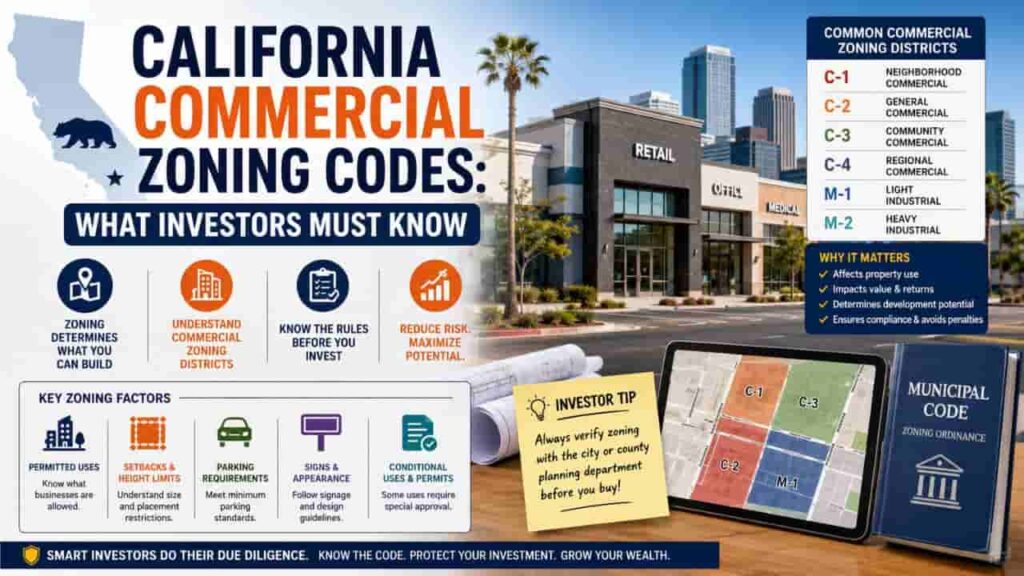
Understanding Common California Commercial Zones with C1, C2, and CC
Because California allows each city to design its own municipal code, the exact letters and names can vary slightly between cities. However, most planning offices use a highly standardized framework for retail zoning and business districts.
The table below breaks down the foundational commercial classifications used across California’s major municipal markets.
| Zoning Tier | Common Code Examples | Allowed Land Uses & Business Types |
| Neighborhood Commercial | C1, CN, CR | Low impact neighborhood businesses, including small grocery storefronts, dry cleaners, professional offices, and cafes. |
| General Commercial | C2, CG, CC | Heavy commercial uses, such as auto repair shops, large shopping centers, hotels, restaurants, and medical clinics. |
| Commercial Mixed Use | CMU, MXD, MU | Integrated properties combining retail storefronts or professional offices on the lower levels with residential units above. |
Key Commercial Design Restrictions
Finding the basic letter designation on a city map is only your initial step. To accurately budget your investment project, you must dig into the specific text of the local ordinances, which regulate three major structural items.
1. Parking Space Requirements
In California, parking space minimums can heavily limit your building’s earning potential. Local municipal codes dictate exact parking space requirements based on your specific type of business and total square footage.
- Professional Offices
Often require 1 parking space per 250 to 300 square feet of usable floor area. - Restaurants and Bars
Can require up to 1 parking space per 100 square feet, or even based on total guest seating counts, to prevent street parking congestion.
Investor Note. Under recent state laws like Assembly Bill 2097 (AB 2097), California has banned cities from enforcing mandatory parking minimums on commercial properties sitting within a half mile of a major public transit stop. This represents a massive opportunity for developers to maximize their total buildable footprint.
2. Floor Area Ratio (FAR) and Building Envelope
Floor Area Ratio (FAR) controls the overall bulk and density of your commercial building. It is calculated using a straightforward formula.
FAR = Total Gross Building Floor Area \ Total Surface Area of the Land Lot

If your target lot is 20,000 square feet and the local city ordinance sets a maximum FAR limit of 1.0, your total building layout cannot exceed 20,000 square feet of interior floor space whether structured as a single story layout covering the whole lot or a two story layout covering half the lot.
The Investor’s Lifeline, CUPs, Variances, and Zoning Amendments
If your proposed business plan does not perfectly match the local “by right” zoning uses, your investment project isn’t necessarily dead. You can pursue three main administrative paths to secure your development approvals.
1. The Conditional Use Permit (CUP) Process
A conditional use permit (CUP) allows a city to review a business model on a case by case basis. For example, if you want to open a nightclub, a drive thru restaurant, or a daycare facility, the city may grant a CUP only if you agree to specific operating conditions, such as.
- Restricting your late night operating hours.
- Building extra security fencing or sound barriers.
- Adding extra security guards during peak business hours.
2. Requesting a Variance
A variance is a special administrative exception that allows you to bypass physical building rules like height limits or side setback requirements. To win approval from a local planning commission, you must prove that the physical shape of your land (such as an extremely steep slope or an odd triangular shape) creates a unique hardship that prevents you from developing the lot normally.
3. Filing a Zoning Ordinance Amendment
This is the most complex and expensive path. It requires convincing the local city council or county board of supervisors to change the official zoning map for your parcel. This process requires extensive public hearings, environmental reviews under the California Environmental Quality Act (CEQA), and can take anywhere from six months to over a year to secure.
Step by Step Zoning Due Diligence for Commercial Buyers
Before you release your earnest money deposit or waive your contingencies on a California commercial contract, follow this step by step verification process.
Step 1. Locate the Official Assessor’s Parcel Number (APN)
Find the unique APN printed on the property’s current county tax bill, or look it up by searching the street address on the local county assessor’s web directory.
Step 2. Identify the Base Zone Code via the Local GIS Map
Open the online interactive GIS mapping portal hosted by the specific city planning department. Input the APN and note the exact alphanumeric code assigned to the lot.
Step 3. Audit the Full Municipal Code Text and Active Overlays
Look up your specific code section within the city’s official municipal code database. Carefully check the “Permitted Uses” table to see if your business type requires a formal conditional use permit (CUP), and review any historic or environmental overlays.
Step 4. Confirm Parking Ratios and Infrastructure Capacity
Calculate your required parking counts against your proposed floor plans. Check with the public works department to ensure the existing sewer, water mains, and electrical grids can support your business activities.
Step 5. Secure an Official Zoning Verification Letter (ZVL)
Submit a formal application to the city planning counter for a certified ZVL. This official document gives you a legally binding confirmation of the land’s zoning status for your lenders and business partners.
Key Takeaways
Mastering California commercial zoning codes is an essential step for building a safe and profitable real estate portfolio. By taking the time to verify your business classifications, audit local parking space requirements, and account for any hidden overlay districts, you protect yourself from expensive code violations and project delays. Never rely on marketing brochures alone—always verify your data through official municipal portals and consult with local planning staff before closing your deal.
FAQs
Can I change a retail storefront into a medical clinic in California?
It depends on the city’s specific rules. Medical clinics often have much higher parking space requirements than retail stores, which might require you to secure a formal conditional use permit (CUP).
What does AB 2097 mean for California commercial real estate?
Assembly Bill 2097 stops California cities from forcing commercial properties to build mandatory parking spaces if the lot sits within a half mile of a major public transit stop.
What is the main difference between C1 and C2 zoning codes?
C1 zones are generally restricted to low impact neighborhood businesses like offices or small cafes, while C2 zones allow for heavier commercial uses like auto repair, hotels, and big box retail centers.
What is a mixed use development overlay?
A mixed use overlay is a flexible planning zone that allows a single property to combine commercial land use (like ground floor retail stores) with residential housing units on the upper floors.
How long does it take to secure a Conditional Use Permit (CUP)?
Depending on the workload of the local planning commission and whether your project requires an environmental review, a CUP application typically takes between 3 to 9 months to process.
Where can I find the official text for a city’s commercial zoning laws?
You can read the full text inside the city’s municipal code database, which is usually hosted on public legal repositories like Municode or American Legal Publishing.
What happens if my business violates local commercial zoning laws?
The city’s code enforcement division can issue formal citations, levy heavy daily fines, and force your business to shut down until the zoning issue is fully resolved.
What is a Floor Area Ratio (FAR) cap?
A FAR cap is a regulatory limit that restricts the total interior floor space of your building relative to the overall surface square footage of the land parcel.
Can I open a commercial warehouse inside a C2 General Commercial zone?
Usually no. Traditional distribution warehouses are classified under industrial zoning codes (like M1 or M2) rather than standard commercial business codes.
Who should I meet with to verify my business plans are compliant?
You should schedule a pre application consultation with an active duty planner at the public planning and building counter at your local city hall.