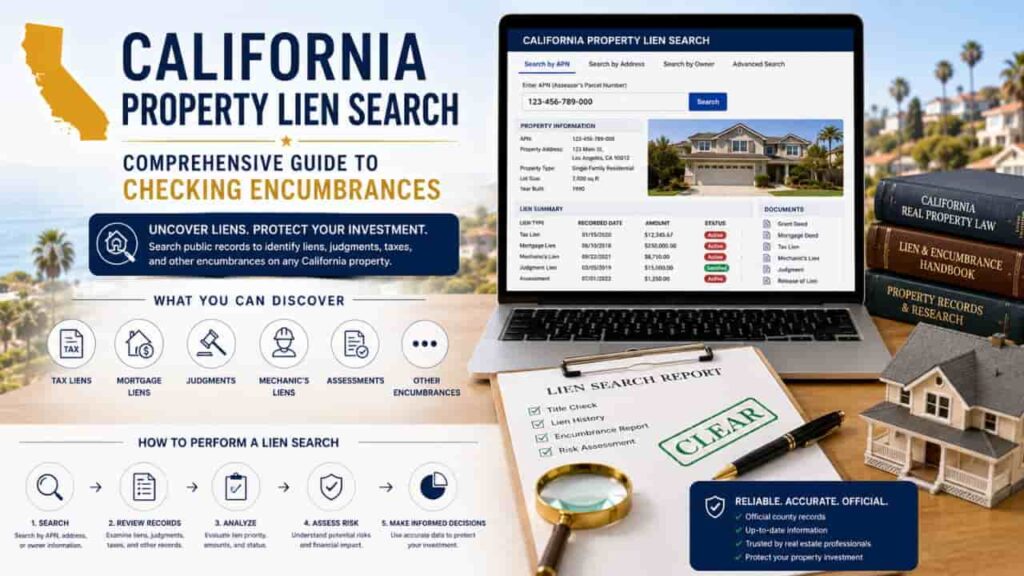
In the competitive California real estate market, purchasing a property without performing a thorough California property lien search is a high stakes financial risk. Under California real estate law, hidden debts attached to a piece of land or building do not disappear when ownership transfers. Instead, these liabilities remain attached to the title, effectively becoming the new owner’s legal and financial responsibility. Whether you are protecting an institutional commercial investment or securing a private asset, executing a strategic property debt check ensures you do not inherit someone else’s unpaid bills or legal entanglements.
What is a Property Lien and Why Does Buyer Protection Matter?
An encumbrance is a legal claim or liability attached to a piece of real estate that affects its value, clear title, or use. A lien is a specific type of financial encumbrance. It acts as a legal security interest granted to creditors, ensuring they get paid when the property is sold or refinanced. If you finalize a purchase on a property that carries unresolved hidden liabilities, those creditors can legally foreclose on your newly acquired asset to satisfy the debt. For commercial buyers and savvy investors, understanding how to unearth these hidden claims through a public records lookup is the ultimate layer of buyer protection.
The 3 Most Common Types of Liens in California
Before diving into the lookup process, you must know what hidden liabilities look like. In California, debt attachments generally fall into three major categories.
1. Tax Liens
When a property owner fails to pay federal, state, or county obligations, government agencies file a claim against the asset. Tax liens can be issued by the IRS for unpaid federal income taxes, the California Franchise Tax Board (FTB) for state taxes, or the local County Tax Collector for delinquent secured property taxes. In California, unpaid property taxes can eventually lead to a public tax default auction after five years for residential properties and three years for commercial assets.
2. Mechanics Liens
If a general contractor, subcontractor, or material supplier performs work on a property (such as a roof replacement or commercial build out) and goes unpaid, they can record a mechanics lien. Under California Civil Code Sections 8000 Reading through 8614, a claimant has a strict window to record this claim against the title.
3. Judgment Liens
When a property owner loses a court case, the winning party can record an Abstract of Judgment with the county recorder. This converts a legal judgment (from contract disputes, medical debt, or personal injury lawsuits) into a secured cloud on the property’s title.
Step by Step Guide, How to Perform a California Property Lien Search
Identifying financial encumbrances requires using local government portals and county administrative offices. Because California manages property records at the county level rather than through a centralized state system, you must target the specific county where the asset sits.
Step 1. Gather Essential Property Identification
You cannot search for records effectively using only a standard street address. To ensure an accurate public search, secure the following data points.
- Assessor’s Parcel Number (APN)
This unique hyphenated number identifies the specific plot of land within the county’s mapping system. - Full Legal Names
Gather the exact names of the current property owners, including corporate entities, LLCs, or trusts, as documents are cross indexed by names.
Step 2. Use the County Clerk Recorder’s Online Index
Every California county from Los Angeles and Orange County to Sacramento and Sonoma maintains a Grantor Grantee Index.
- Grantor. The party transferring property rights or owing money (the seller/debtor).
- Grantee. The party receiving rights or holding the claim (the buyer/creditor).
Most counties provide an online search portal for this index. While you can view document numbers, recording dates, and document types (e.g., “Lien,” “Release of Lien,” “Notice of Delinquency”) online for free, California law generally prohibits counties from displaying actual, viewable images of recorded documents directly on the open internet for privacy reasons.
Step 3. Visit the Recorder’s Office or Order Copies
If your online index search flags a document title like “Claim of Lien” or “Abstract of Judgment,” you must see the text to find the exact debt amount and claimant details.
- In Person Records Inspection
You can visit the local County Recorder’s office to view document images on public service terminals at no cost. - Purchasing Certified Copies
If you cannot visit in person, you can order official copies online or by mail. Expect to pay standard California statutory fees, which typically average $3.00 for the first page and $1.00 for each subsequent page, along with an optional fee for official certification under seal.
Hidden Pitfalls, What County Records Might Miss
While a public records lookup at the county recorder is a critical phase of due diligence, it does not reveal every risk. Certain claims do not appear on the Grantor Grantee index immediately, creating a dangerous blind spot for unassisted buyers.
| Type of Hidden Risk | Why It Misses the County Recorder Index | How to Uncover It |
| Municipal Utility Debts | City water, trash, and sewer bills stay tied to the parcel but aren’t recorded as formal title liens until they face extreme delinquency. | Request a utility payoff verification directly from the local city or municipal utility district. |
| Unrecorded Mechanics Claims | Contractors have up to 90 days after project completion to record a formal claim. A title can look completely clean during escrow while an unrecorded claim is pending. | Review recent construction permits, issue an owner affidavit, or request unconditional lien waivers. |
| Pending Court Litigation | Lawsuits affecting property ownership or commercial assets filed in the California Superior Court don’t automatically show on land records until a Lis Pendens (Notice of Pendency of Action) is formally recorded. | Conduct an independent civil index search using the local California Superior Court public portal. |
The Role of a Title Company in Securing Your Investment
For complete safety, commercial buyers and traditional home purchasers should not rely solely on a manual DIY lookup. Hiring an independent, licensed title company is the gold standard for institutional buyer protection. During a transaction, a title company employs professional abstractors to execute an exhaustive title search across multiple databases, including county land records, tax databases, and court judgment indexes. They compile these findings into a Preliminary Title Report (Prelim). This document outlines every active encumbrance, restriction, and easement that must be cleared before closing escrow.
Expert Experience Note. As a real estate professional working within California’s regulatory framework, I have seen simple clerical errors on names or outdated index records derail a transaction at the last minute. Relying strictly on a manual search without securing a Title Insurance Policy leaves you exposed. A comprehensive Title Insurance Policy protects you against hidden defects, forged signatures, or unrecorded claims that may emerge after closing.
Clearing the Title, How to Remove a Lien
If your search reveals an active cloud on the title, the escrow process cannot proceed cleanly until it is resolved. Erasing these financial obligations follows specific legal pathways depending on the debt.
- Lien Payoff and Satisfaction
The most straightforward path involves paying the creditor in full from the seller’s proceeds at escrow closing. Once paid, the creditor executes and records a formal Substitution of Liability or Satisfaction of Judgment. - Disputing an Expired Mechanics Claim
Under California Civil Code Section 8460, a contractor must file a foreclosure lawsuit within 90 days of recording a mechanics lien. If they miss this deadline, the claim becomes legally “stale” and unenforceable. If the contractor refuses to file a voluntary release, the owner can file a petition in court to order its removal. - Lien Release Bonds
If a commercial buyer or developer wants to dispute a claim without halting a sale, they can purchase a Mechanics Lien Release Bond through a California admitted surety company. This bond must equal 125% of the claimed sum, lifting the financial hold from the real estate and attaching it to the bond instead.
Conclusion
Running a comprehensive California property lien search is an indispensable phase of investor due diligence that protects your capital from hidden financial liabilities. Because California’s property records are decentralized across 58 county jurisdictions and governed by strict online data privacy laws, finding active encumbrances requires matching specific Assessor’s Parcel Numbers (APNs) with localized Grantor Grantee indexes. Whether you are dealing with tax defaults, judgment encumbrances, or unrecorded mechanics claims, validating your title search data ensures you close escrow securely without inheriting the debts or legal disputes of past owners.
FAQs
How do I do a property lien search in California?
Locate the property’s Assessor’s Parcel Number (APN) online, then query that parcel and the owner’s name in the specific County Recorder’s Grantor Grantee public index.
Can I check for property liens online for free in California?
Yes. Most county clerk recorder websites let you search the public records lookup index for free, though viewing or downloading actual copies of recorded deed documents requires a fee.
What is the standard fee to print a property lien document in California?
California statutory recorder fees typically average $3.00 for the first page and $1.00 for each additional page, plus an optional $1.00 fee to get it officially certified.
How long does a mechanics lien stay active on California real estate?
Under California Civil Code Section 8460, a mechanics lien is valid for only 90 days after recording unless the contractor files a formal foreclosure lawsuit within that exact window.
Why don’t municipal utility debts show up on a county lien search?
Cities often hold outstanding water, trash, or sewer bills internally. These property debts do not appear in county public records until they reach extreme delinquency and trigger a formal tax default.
Can an IRS tax lien force the sale of my house in California?
Yes. Federal tax liens take priority over many claims. The IRS can legally execute a seizure and property foreclosure to recover delinquent income tax debts owed by the parcel owner.
What is a property lien release bond in California?
It is a surety bond equal to 125% of a disputed debt amount. Filing this bond legally lifts a mechanics lien or claim off the real estate, freeing up the title.