Whether you are a real estate investor scouting an abandoned lot, a homebuyer conducting due diligence, or a neighbor trying to resolve a boundary dispute, finding the current owner name of a piece of land is a common hurdle. In California, however, this task is not as straightforward as typing a name into a state database. The Golden State enforces some of the country’s most stringent data privacy laws, which completely alter how public records can be viewed online versus offline. To bypass the roadblocks and avoid expensive third party data scraping scams, you need to understand exactly how the decentralized county system works and follow legal, official public avenues.
The Digital Roadblock, California Government Code Section 7928.205
Many researchers open up their browser, locate a county portal, and quickly realize they cannot perform a simple online property ownership lookup using a name or address. This restriction is entirely intentional and rooted in California law. Under California Government Code Section 7928.205, state and local agencies are strictly prohibited from publicly posting identifying personal information on the internet without explicit written permission. This statute specifically covers the names, telephone numbers, and Assessor’s Parcel Numbers (APNs) associated with the primary home addresses of elected or appointed officials, law enforcement personnel, and judges.
To maintain total compliance with this safety mandate, almost all 58 California counties have chosen to redact all consumer facing owner names from their online search portals. Therefore, if you search an address on the Los Angeles County Assessor or Orange County website, you will successfully view the physical building characteristics and tax valuations, but the current owner name line will typically display as “Withheld,” “Hidden,” or remain completely absent.
Where Official Ownership Records Are Held
Because the state does not operate a single centralized registry, property records are split across two separate county administrative offices. To get a complete title search and deed history, you must understand what each office is legally required to maintain.
| Government Agency | Primary Record Type | Online Accessibility Restrictions | Best Used For |
| Office of the County Assessor | Tax Assessment Rolls, Parcel Maps, and Property Characteristics. | Strict name redactions under Code Section 7928.205. | Finding the APN, land square footage, land use zoning, and assessed values. |
| County Clerk Recorder | Legal Land Instruments, Encumbrances, and Title Changes. | Open indexes online; raw deed images usually require an in person visit or fee. | Accessing Grant Deeds, checking for liens, and tracing ownership chain. |
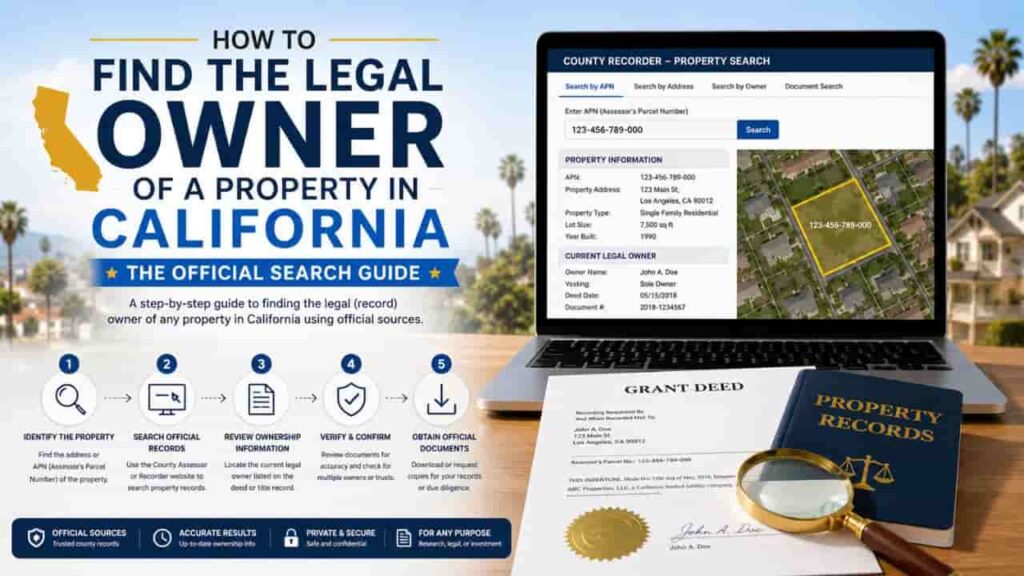
Step by Step Blueprint to Find a California Property Legal Owner
If you are trying to identify who owns a specific house or vacant land parcel, follow these verified, step by step institutional methods to retrieve authentic data.
Step 1. Extract the Assessor’s Parcel Number (APN) Online
Even though you cannot find the owner’s name online, you can find the parcel’s unique identifier.
- Go to the official tax assessor records website for the specific county where the property is located (e.g., San Diego County Assessor Recorder County Clerk portal). Ensure the URL ends in
.gov. - Open their interactive GIS (Geographic Information System) parcel map or property assessment portal.
- Input the physical street address.
- Write down the multi digit Assessor’s Parcel Number (APN). This number acts as the unique coordinate system for all legal transactions concerning that property.
Step 2. Utilize In Person Public Terminals (The Absolute Best Method)
While state privacy laws explicitly ban counties from putting owner names on the internet, they do not limit public access to physical records. The California Public Records Act guarantees your right to inspect the complete, unredacted assessment roll directly inside the government building.
- Visit the local branch or main office of the County Assessor or County Clerk Recorder.
- Locate the public access computer kiosks.
- Input the street address or the APN you secured in Step 1.
- The screen will display the unredacted current owner name, mailing address, transfer dates, and prior transaction history. Viewing this on screen is completely free.
Step 3. Run a Search via the Grantor/Grantee Index
If you cannot visit the county office in person, you can use the County Recorder’s online public indexes to work backward.
- Log into the County Clerk Recorder’s online portal.
- Access the Grantor/Grantee Index. (The Grantor is the party selling or transferring the land; the Grantee is the recipient/buyer).
- Look up historical transaction filings linked to the specific parcel or neighborhood block. When a property transfers ownership, a Grant Deed or Quitclaim Deed must be recorded.
- By locating the most recently recorded deed instrument, you can view the legal names of the parties involved in the transfer.
Step 4. Deconstruct Corporate Entities and Trusts
Many high value properties or investment parcels in California are not registered to individuals. Instead, the deed history will show the owner as an entity, such as “Pacific Coast Holdings LLC” or “The Smith Family Trust.”
- For Trusts
The public deed will name the Trustee (e.g., “John Doe, Trustee”). Under California estate laws, the private beneficiaries of the trust are shielded, meaning the Trustee is your primary legal point of contact. - For LLCs and Corporations
Copy the exact name of the entity from the deed. Go to the California Secretary of State (SOS) Business Search Portal. Run a free business entity search to view the Statement of Information (SOI). This official public filing lists the names and mailing addresses of the managing members, CEOs, and registered agents behind the company.
Alternative Solutions for Remote Searches
If an in person visit is out of the question and the online indices are proving too complex, you have two alternative expert avenues.
- Certified Title Plants & Private Abstractors
You can pay a licensed title insurance company or a local title abstractor to run a preliminary title report. Because title plants maintain private, mirror copies of county land indices for underwriting insurance, they can instantly pull up to date deed histories and owner profiles for a minor fee. - Mailing a Public Records Request
Under the California Public Records Act, you can submit a formal written request or a document order form to the County Recorder’s office to purchase a copy of the latest recorded deed for a specific parcel. You will need to provide the APN or Document Recording Number and enclose a small processing fee (typically between $5 and $15 per page).
Conclusion
Finding a property legal owner in California requires working within strict online redactions mandated by Government Code Section 7928.205. While consumer portals hide current owner names to protect privacy, executing an in person public index search or tracking deed histories via the county clerk recorder’s grantor/grantee index yields authentic results. By extracting the Assessor’s Parcel Number (APN) and researching corporate filings through the Secretary of State, investors and professionals can efficiently trace land titles and verify true real estate ownership across all 58 counties.
FAQs
How do I find a property owner’s name in California for free?
Look up the property’s APN on the official County Assessor website, then visit their physical office to view the unredacted public assessment roll on their lookup terminals.
Why are owner names hidden on California property search websites?
California Government Code Section 7928.205 prohibits counties from publishing personal identifying information online to protect the privacy and safety of public officials, law enforcement, and judges.
Can I do a California property ownership lookup by name?
Yes, but only through the County Clerk Recorder’s online Grantor/Grantee index. You can search the index by name to trace historical deed recordings and land title transfers.
How do I perform a free title search in California?
You can search the official Grantor/Grantee public index at the County Recorder’s office for free to view the chain of title, liens, and recorded deed history.
How can I find out who owns an LLC registered property in California?
Copy the LLC name from the deed and search it on the California Secretary of State (SOS) Business Portal to view their public Statement of Information filing.
Where can I find tax assessor records for California real estate?
Access the official Office of the Assessor portal for the specific county where the parcel sits. Ensure the website domain ends in a verified .gov extension
What should I do if a California property owner is a trust?
Review the recorded deed at the recorder’s office to find the named Trustee. Legally, the trustee serves as the official public contact for the private trust entity.
Disclaimer. This guide is designed as an educational and informational tool for working with public data infrastructure in the State of California. It does not constitute formal legal counsel, real estate brokerage representation, or private investigative services. Document access, portal features, and county fee structures remain subject to localized updates and independent municipal adjustments.