The digital age has made it incredibly convenient to look up real estate assets. With a few clicks, you can access tax portals, structural values, and interactive mapping layouts. However, relying strictly on an online property search in California can create a false sense of security. Due to strict privacy legislation, archival gaps, and varying municipal budgets across California’s 58 counties, digital records often provide an incomplete picture. To execute ironclad real estate due diligence, you must understand exactly where digital data falls short and when an offline, in person search is required to protect your capital.
The Digital Shield, Understanding Online Land Record Constraints
Many people assume that every document filed at a county administration building is scanned and uploaded to the internet. In California, this is simply not true. Government frameworks place significant legal and structural limitations on open source web networks.
The Impact of California Assembly Bill 1785
A major shift occurred with the implementation of Assembly Bill 1785. This privacy mandate prohibits county recorders across California from allowing public searches of official land title indexes using an Assessor’s Parcel Number (APN) on the open internet. The legislation aims to reduce automated scraping, title fraud, and phishing schemes targeting homeowners. Consequently, online tracking portals in major hubs like San Diego, Ventura, and Kern counties have removed online APN search options. If you do not possess the exact legal name of the individual or corporate entity holding title, your web based research can hit a dead end, forcing you to use offline alternatives.
The Limits of Document Previews
Even when an online index allows you to locate a filing such as an active mortgage or a contractor claim, California Government Code Section 6254.21 bars counties from displaying unredacted, viewable images of recorded land documents on the open internet without restriction. Web systems function as index registries only, showing the document number, date, and names involved. To inspect the actual text, find execution terms, or view specific property boundaries, you must pay online copy fees or visit a regional office.
Head to Head Comparison, Online vs Offline Systems
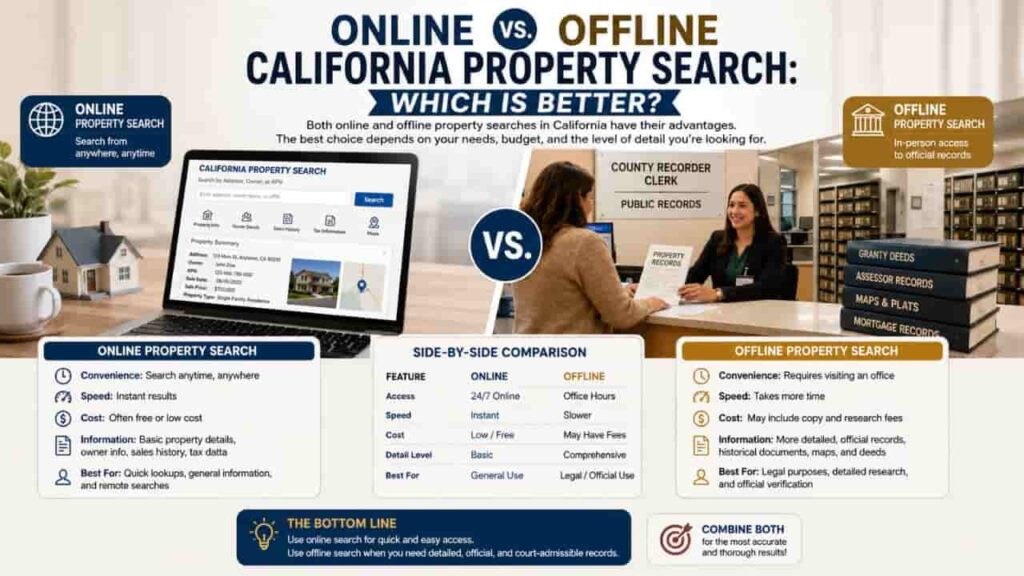
To choose the right approach for your real estate transactions, it helps to weigh instant property data against deep historical accuracy.
| Performance Metric | Online Property Search Framework | Offline In Person Investigation |
| Research Speed | Delivers instant information across connected computer networks. | Requires physical travel time, scheduling counter appointments, and manually working through files. |
| Archival Depth | Generally capped at modern filings, with most digital indexes only going back to the mid 1980s or 1990s. | Provides access to comprehensive history, reaching back to handwritten Spanish Mexican land grants and 19th century files. |
| Search Capabilities | Restricted to searching by name or document number due to state privacy laws like AB 1785. | Complete search flexibility using physical maps, APN indexes, or internal data networks. |
| Associated Costs | Free index viewing, but requires premium credit card checkout fees to download document files. | Zero cost to inspect records on site; standard statutory copy fees apply only if you print pages. |
Why Smaller Counties Require an In Person Lookup
If your investment strategy leads you outside major metropolitan areas like Los Angeles or Orange County, your reliance on digital tools can become a liability.
The Technological Divide in Rural Counties
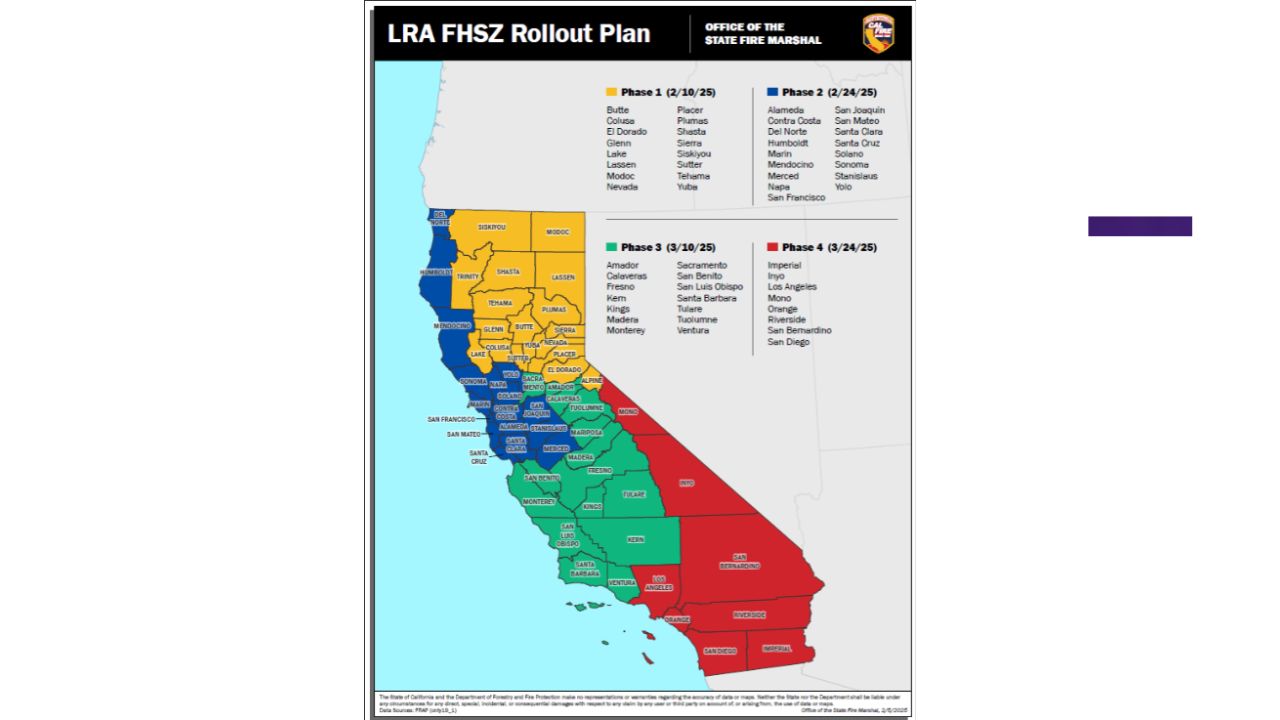
Smaller, rural regions such as Alpine, Mono, Mariposa, or Modoc counties operate with limited administrative budgets. Many of these areas do not maintain custom web search applications or automated online databases. Instead, their registries remain entirely offline or utilize third party portals like ParcelQuest for basic property characteristics, while historical title records remain securely inside the physical office.
Missing Historical Documentation
In these regions, tracing a clear chain of title or hunting for old prescriptive easements means working through a physical county registrar setup. Important documents might be stored on microfilm records, microfiche cards, or within giant leather bound ledger books. Assuming a title is clear simply because a small county’s basic website shows no active flags is a dangerous mistake. An unrecorded conflict or ancient judgment could sit entirely unindexed on an offline ledger, waiting to surface after your transaction closes.
When You Must Go Offline, The Power of Kiosks and Archives
For comprehensive due diligence, certain records demand an in person visit to a local government office.
Leveraging Public Computer Kiosks
When you step inside a local county recorder’s lobby (such as the Registrar Recorder/County Clerk branches in Norwalk, Van Nuys, or Riverside), you gain access to internal public computer kiosks. Because these terminals are physically located within a secure government building, they are exempt from the online restrictions mandated by AB 1785. On a public kiosk, you can instantly search property histories by APN, view complete, unredacted document images on screen for free, and locate filings that are blocked from home viewing.
Accessing Historic Construction and Plot Maps
If you are investigating property boundaries, historic lot line adjustments, or structural changes, an online search will often fall short. Government Code Section 7928.205 restricts posting detailed spatial maps and construction designs on the internet to protect infrastructure security. To review these records, you must visit the public records counter. There, staff can pull original subdivision layouts, grading permits, and structural files from off site storage or internal digital document management systems.
Action Plan, Building a Secure Due Diligence Workflow
To optimize your real estate research while protecting your capital, combine the speed of online tools with the thoroughness of offline records.
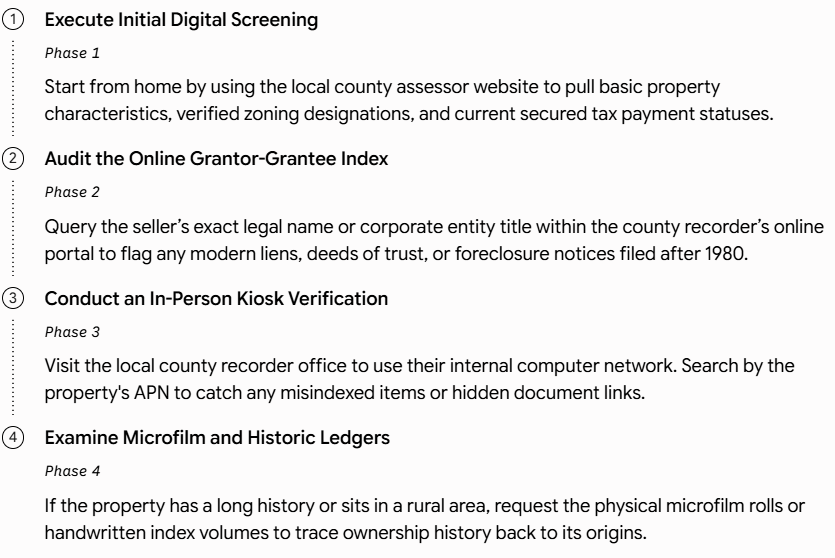
Professional Advisory Note. While a manual combination of online and offline research is excellent for initial deal screening, it should never replace a professional title search. Before finalizing any real estate transaction in California, always secure a Preliminary Title Report and a comprehensive Title Insurance Policy from a licensed title company to legally protect your investment from hidden defects.
Conclusion
Deciding between an online property search in California and an offline, in person investigation requires balancing digital speed with historical accuracy. While web portals provide instant property data, data privacy mandates like Assembly Bill 1785 and municipal budget limits create critical gaps in online public records. To establish an ironclad chain of title, sophisticated investors must combine digital screening with manual, on site lookups using internal public computer kiosks and microfilm records at the local county registrar. This dual layer approach remains the definitive industry benchmark for comprehensive real estate risk mitigation.
FQAs
Why can’t I find all California property records online?
Strict state privacy laws, like Assembly Bill 1785, restrict posting personal data online. Additionally, many rural counties lack the budget to digitize historical records.
What is a public computer kiosk in a county recorder’s office?
It is a secure, on site terminal exempt from web hosting restrictions. It allows you to search by APN and view unredacted document images for free.
How far back do online property searches in California go?
Most digital land registries only extend back to the mid 1980s or 1990s. Older historical files require searching physical books or microfilm records.
Can I look up property encumbrances by APN on the internet?
Generally, no. Due to privacy mandates, most California county registrar portals require a debtor’s name or document number rather than an APN.
Why are smaller California counties harder to search digitally?
Smaller counties operate on limited administrative funding and often maintain no online index, requiring an in person lookup for title verifications.
Are building blueprints and parcel maps viewable on public websites?
No. Government Code Section 7928.205 restricts hosting detailed structural layouts online for security reasons, making an offline counter request necessary.
Does a clean online property search guarantee a clear title?
No. Digital indexes can have omissions or miss unrecorded liabilities. True validation requires an in person search or an official preliminary title report.