A diverse portfolio of residential or commercial real estate means keeping strict track of financial transaction records. If you rely on an automated mortgage impound account, never blindly assume your loan servicer hits deadlines perfectly. Clerical delays or data synchronization glitches at major servicing banks happen more often than you think, and they can trigger direct, non negotiable 10% delinquency penalties on your parcel. To safeguard your real estate equity and maintain absolute asset protection, you must know how to pull public records directly from your local county tax portal. This comprehensive expert guide breaks down exactly how to navigate a California county tax portal, extract your unique parcel data, and verify that your lender tax payment has cleared the county ledger successfully.
Why You Must Personally Audit Your Escrow Tax Payments
When you establish a mortgage impound account, your loan servicer collects a portion of your property taxes each month as part of your monthly mortgage payment. While this creates a convenient budgeting pipeline, the legal liability for delinquent taxes ultimately rests on the property owner. Relying entirely on a bank without performing an independent escrow analysis or payment check leaves you vulnerable to administrative errors. California county tax collectors are unyielding, if a payment is missed, a penalty is applied instantly, regardless of who made the mistake. Checking your status online takes less than five minutes and serves as your primary line of financial defense.
Step 1: Locating Your California Assessor’s Parcel Number (APN)
Before you can query any digital property tax interface in California, you must locate your specific account identification number. California county portals do not prioritize standard street or mailing addresses; their relational databases track accounts via a unique multi-digit code known interchangeably across regions as:
- APN (Assessor’s Parcel Number)
- AIN (Assessor’s Identification Number — uniquely utilized in Los Angeles County)
- PIN (Parcel Identification Number)
You can easily locate this unique identifier printed at the very top of your grant deed, on your preliminary title insurance policy paperwork, or directly on the informational duplicate copy of your annual secured property tax bill mailed out every October.
Comprehensive California County Portal Lookup Directory
Different municipal regions process property transactions through vastly unique online infrastructures. The following reference data outlines how major economic hubs structure their online property verification pipelines, what data inputs they require, and where to look:
| County Jurisdiction | Official Tax Portal Name | Required Input Search Criteria |
| Los Angeles County | LA County Property Tax Portal | 10-Digit AIN (Format: 0000-000-000) |
| Orange County | OC Treasurer-Tax Collector | 12-Digit APN or Full Property Situs Address |
| San Diego County | SDTTC Online Parcel Tax System | 10-Digit APN or 8-Digit Bill Number |
| Riverside County | Riverside County TTC Portal | 9-Digit Assessment Number or APN |
| Sacramento County | Sacramento County Online Tax Bill | 14-Digit Parcel Number |
Step by Step: How to Verify Payments on Your County Portal
Once you have retrieved your specific parcel identifier, use this tactical step by step sequence to run a secure query and audit your lender’s performance.
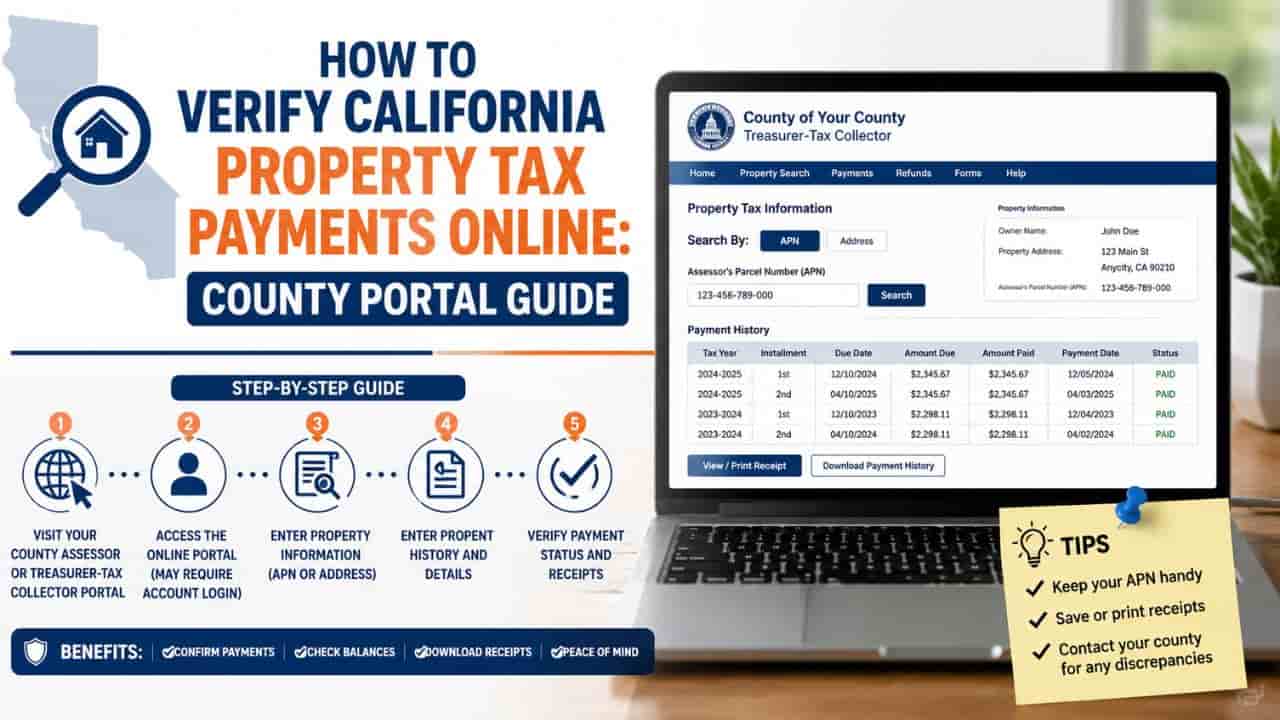
1.Access the Official County TTC Domain: Prerequisite.
Open your secure web browser and navigate strictly to the official .gov or verified county-level payment portal extension listed in our directory. Avoid secondary, third-party lead generation tracking websites.
2.Execute the Parcel ID Query: Data Entry.
Input your APN, AIN, or unique property address into the primary search fields. Eliminate hyphens or spaces unless the specific regional user interface explicitly prompts you to include them.
3.Filter by the Correct Fiscal Tax Cycle: Temporal Filtering.
Ensure you are analyzing the current active fiscal year layout. Remember, California property tax calendars track data cross-annually from July 1st through June 30th of the subsequent year.
4.Audit Clearance and Installment Settlement Status: Audit Clearance.
Locate the distinct visual entries for “1st Installment” (delinquent after December 10) and “2nd Installment” (delinquent after April 10). If your lender successfully completed the transfer, the status column will read “PAID” accompanied by an explicit processing transaction timestamp.
Troubleshooting Portal Discrepancies and Open Balances
What happens if your portal ledger states “UNPAID” less than 7 business days before a major delinquency deadline? Do not immediately panic, but take immediate structural steps to diagnose the issue:
1. Identify Delayed Batch Processing
Many corporate loan servicing systems execute payments using large electronic data interchange (EDI) clearings. During peak cycles (early December and early April), the county database may take up to 48 hours to update and display the payment, even if the funds have already been wire-transferred.
2. Handle Supplemental Bill Exclusion
If you notice an unexpected open balance under a separate supplemental property tax bill line item, your primary mortgage escrow account did not receive or process it. Because lenders ignore tracking secondary reassessments after a sale, you must handle this balance manually or send a physical copy to your lender to adjust your impound account cushion.
3. Issue an Immediate Real Estate Notice of Error (NOE)
If a delinquency deadline passes and your lender failed to execute a disbursement from an active, fully funded impound fund, mail a certified Notice of Error immediately. Under federal regulatory rules, the servicer has strict statutory timelines to resolve the error and pay any resulting 10% late fines entirely out of pocket.
Final Thoughts from an Escrow Specialist
Maintaining absolute authority over your property portfolios means building an independent verification protocol. While automated tracking tools offer great operational convenience, manually cross-checking your County Treasurer-Tax Collector portal twice a year keeps your business fully insulated from systemic banking oversights. Utilizing a mortgage impound account ensures your monthly mortgage payment handles your core liabilities smoothly, but it will not shield you from sudden structural tax adjustments. Consistently auditing your account prevents costly structural surprises, ensuring your lender tax payment hits every critical county deadline while fully preserving your long-term residential equity.
Expert Insights by Daniel W. Foster | Real Estate Analyst
FAQs
What happens if my APN search yields zero database results?
Ensure you have removed all spaces or formatting hyphens. If errors persist, verify your land records through your specific county’s interactive GIS mapping index to check for recent parcel splits.
Why does the county portal ask for a PIN code?
Select counties like Orange County require a secondary 6-character alphanumeric PIN found exclusively on your physical printed tax bill to protect title data privacy.
How long does an eCheck payment take to clear the portal?
Standard eCheck clearances post to California portal balances within 1 to 3 business days, showing an electronic settlement date retroactively matching your submission.
Is a mortgage impound account mandatory for all California home loans?
FHA and VA loans strictly require them. Conventional loans with less than a 20% down payment typically mandate an escrow layout to mitigate risk.
Does my escrow account cover California supplemental property tax bills?
No. Lenders calculate your account using standard annual bills. Supplemental invoices are sent directly to you and require separate payment.
How often does a bank perform an escrow analysis?
Federal law requires loan servicers to execute a comprehensive escrow analysis at least once every 12 months to recalculate payment amounts.
What happens if my impound account has an escrow shortage?
Your lender will allow you to pay the deficit via a one-time lump sum or spread it across your next twelve monthly installments.
Can I cancel my property tax escrow account later?
Yes. Once your loan principal balances drop below 80% loan-to-value (LTV), you can formally request escrow cancellation from your servicer.
What is a standard escrow account cushion under RESPA rules?
Under federal guidelines, lenders can legally maintain a financial cushion equal to two months of standard monthly escrow allocations.
Why did my monthly mortgage payment increase after an escrow review?
An increase indicates a local property tax hike or insurance premium jump, triggering an immediate monthly adjustment to cover the calculated shortfall.