Understanding how to check the tax records and official assessed value of any real estate parcel is a fundamental requirement for executing successful property transactions in California. Whether you are an active real estate investor executing deal due diligence, a digital content developer framing property statistics, or a local homeowner preparing for annual financial obligations, accessing these metrics securely protects your transaction timeline. Unlike states where real property is aggressively re appraised to current market levels every single year, California operates under a highly protective, structured land valuation architecture. To effectively conduct a California property tax records lookup, you must know how to pull historical data files, calculate value trends, and understand the structural divisions of local government systems.
The Legal Foundation, Understanding California Proposition 13
To accurately interpret a historical asset valuation report, you must first master the primary legislation that dictates how California property values are established.
The Impact of Proposition 13 on Tax Caps
Passed by voters on June 6, 1978, Proposition 13 amended the California Constitution to completely restructure how real estate is assessed and taxed. Under this legal framework, a property’s baseline ad valorem tax rate is strictly capped at 1% of its overall assessed property value, plus any local voter approved bonds or local structural district fees.
“Under Proposition 13, real property is assessed at its baseline value when acquired and cannot increase by an inflation factor of more than 2% annually unless a change in ownership or new construction occurs.” California State Board of Equalization
The Base Year Value Concept
When a California property changes hands or undergoes new structural construction, the local county assessor establishes a new “Base Year Value” matching the current fair market acquisition price.
As long as the asset remains with the same owner, its taxable foundation is shielded. The assessor cannot increase the property’s value by more than 2% per year or the rate of inflation (tracked via the Consumer Price Index), whichever is lower. This baseline configuration shifts California from a standard market value system to a predictable, acquisition value based model.
Technical Differences in California Real Estate Tracking
When you log into a local county database to view financial asset profiles, the data is split into distinct regulatory registries.
| Record Framework | Primary Asset Inclusion | Assessment Regulation Rule |
| Secured Assessment Roll | Real property, including land plots, permanent structures, residential homes, and commercial buildings. | Governed strictly by Proposition 13; annual value increases are tightly capped at a maximum of 2%. |
| Unsecured Assessment Roll | Personal property that can be moved, including commercial equipment, private airplanes, and luxury boats. | Assessed at fair market value every single year on January 1st; not shielded by Prop 13 baseline caps. |
| Supplemental Tax History | Adjustments triggered immediately following a recent property transfer or new construction completion. | Captures the tax variance between the old owner’s base value and the buyer’s new market purchase price. |
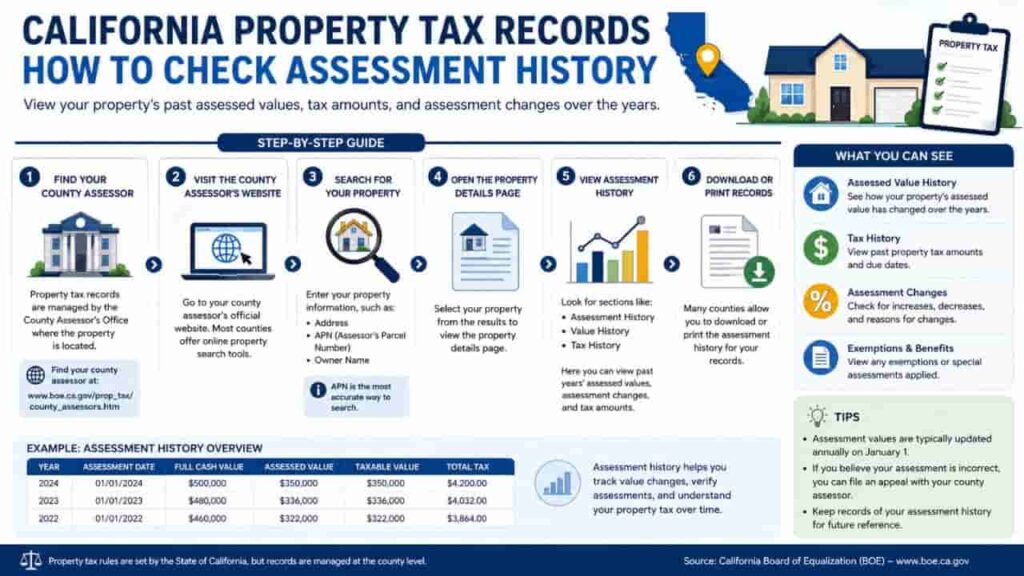
Step by Step Guide to Executing a Property Tax Records Lookup
To trace an asset’s valuation history and download certified municipal registries without facing indexing delays, utilize this step by step structural workflow.
Step 1. Secure Baseline Property Identifiers
Before querying a government network, you must gather precise geographic coordinates or parcel tracking tags.
- Document the exact physical street address, including the city and zip code.
- Locate the unique Assessor’s Parcel Number (APN). This hyphenated identification tag can be found on local parcel maps, structural deeds, or old zoning documentation.
Step 2. Query the Local County Assessor Portal
The County Assessor is the sole government official responsible for locating, describing, and valuing all real estate assets within their county line.
- Go to the official website of the local county assessor where the property sits (such as the LA County Assessor Portal, San Bernardino ARC, or the San Diego ARCC interface).
- Enter the parcel identity markers into their public property search tool.
- Access the secured assessment roll summary page to analyze the current land value split, structural value breakdown, and any active property exemptions (like the standard $7,000 Homeowners’ Exemption).
Step. Access the Treasurer Tax Collector Database
While the assessor determines the property’s valuation, a separate agency handles billing and payments. To view the actual tax bill history and past payments, you must transition to a different database.
- Open the local County Treasurer Tax Collector (TTC) website.
- Input the property’s APN into their secured public payment search screen.
- Review the complete rolling ledger of past tax bills. This portal displays both annual installments, the breakdown of special ad valorem assessments (such as Mello Roos infrastructure bonds), and current payment verification statuses.
Addressing Value Declines, A Leveraging Proposition 8 Relief
If economic shifts or localized natural disasters cause a property’s actual market value to drop below its legally capped Proposition 13 baseline, a property owner can secure temporary tax relief.
The Mechanics of a Proposition 8 Filing
Passed immediately after Prop 13, Proposition 8 allows the county assessor to temporarily lower a property’s assessed value to reflect its actual, lower market value as of the January 1st lien date. This protection ensures you do not pay taxes on an inflated valuation if real estate prices drop significantly. i.e Alameda County Assessor
Restoring the Property Tax Base
It is critical to note that Proposition 8 reductions are temporary adjustments, not permanent base year resets. As local economic conditions improve and neighborhood home prices recover, the county assessor will systematically increase your property’s taxable valuation back to its original Proposition 13 baseline level.
During this recovery phase, the annual valuation increases can legally exceed the standard 2% limit because the assessor is restoring an old value rather than creating a new one.
Strategic Blueprint for Managing Real Estate Tax Profiles
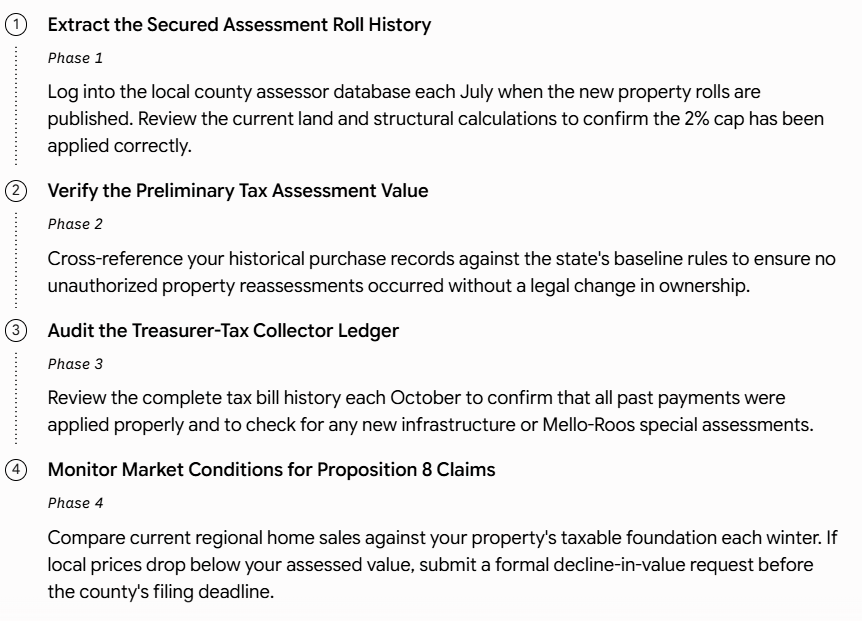
To manage asset portfolios, maintain tax compliance, and streamline data compilation for target properties, implement this verification sequence.
State Agency Advisory Note. The California State Board of Equalization (BOE) acts strictly as a regulatory oversight body to ensure all 58 individual county assessors follow property tax laws uniformly. The BOE does not maintain or issue individual property tax bills. For specific property inquiries, payment updates, or assessment appeals, you must work directly with the local county agency where the real estate asset is located.
Conclusion
Mastering a California property tax records lookup is the definitive strategy for understanding the state’s acquisition value real estate economy. Thanks to Proposition 13, analyzing an asset’s secured assessment roll history provides a predictable foundation for forecasting annual financial liabilities, since it tightly caps assessed property value compounding at a maximum of 2% annually. By cross referencing values published by the Board of Equalization against historical tax bill history archives, real estate professionals can reliably isolate financial irregularities, accurately capture supplemental values, and identify hidden liabilities before finalizing any transactions.
FAQs
What is a California property tax records lookup?
It is an online or offline search used to view a parcel’s historical tax assessments, active collection bills, and certified payment tallies.
How does Proposition 13 impact my property tax records?
Proposition 13 legally caps your base ad valorem property tax rate at 1% of the assessed property value and limits annual inflationary assessment increases to 2%.
Where can I find the official assessed property value in California?
You can search the secured assessment roll directly on the local County Assessor’s website using the property’s unique Assessor’s Parcel Number (APN).
What is the main role of the Board of Equalization?
The California Board of Equalization (BOE) oversees regulatory compliance across all 58 county assessors to ensure state property tax assessment standards are applied uniformly.
Why does my California tax bill history show a rate higher than 1%?
While Proposition 13 caps the general tax levy at 1%, local voter approved bonds, school district levies, and special Mello Roos assessments are added on top.
What is the difference between secured and unsecured assessment rolls?
The secured assessment roll covers permanent real estate like houses and land, while the unsecured roll covers movable commercial assets, equipment, boats, and airplanes.
How do I look up my historical property tax bill history?
You can query your property’s rolling financial ledger online via the official website of the local County Treasurer Tax Collector (TTC).
What triggers an official property reassessment in California?
Under state law, a parcel’s base year value is only re appraised to current fair market value upon a formal change in ownership or completion of new construction.
Can my property assessment increase by more than 2% in a single year?
Yes. If your property previously received a temporary Proposition 8 market decline reduction, the assessor can restore it to its higher Proposition 13 baseline as the market recovers.
What is a supplemental property tax bill in California?
It is a one time bill capturing the tax difference between the seller’s old baseline valuation and your new purchase price from the date of transfer.