Transferring or updating real estate title in California requires following a precise legal protocol. Whether you are executing a transfer between family members, adding a spouse to a title, or finalizing an investment acquisition, failing to record your deed properly can result in immediate document rejection by the county, unexpected tax liabilities, or clouding the chain of title. Because California’s 58 counties manage land recordings in a completely decentralized system, you must follow strict state statutory formatting and reporting rules. This expert guide provides a professional, step by step framework to successfully record a property deed with any California County Clerk Recorder while remaining compliant with California Revenue and Taxation Codes.
Understanding California Property Deeds and Recording Documents
Before initiating the filing process, you must select and draft the appropriate deed instrument. The two most frequently utilized deeds for changing or verifying titles on California real estate are Grant Deeds and Quitclaim Deeds. Choosing the wrong document can unintentionally alter your legal protections.
The Role of the County Clerk Recorder
The County Clerk Recorder acts as the custodian of public land records. Their job is not to verify the legal validity or truth of the claims on your document; their sole responsibility is to ensure the document meets all California Government Codes before indexing it into the public registry. Once indexed, the document provides constructive notice to the public regarding who holds a legal interest in the property.
Primary California Deed Instruments Compared
| Feature | Grant Deed | Quitclaim Deed |
|---|---|---|
| Core Legal Function | Transfers full property ownership rights to the new owner. | Transfers only the interest the grantor currently has, if any. |
| Implied Warranties | Yes. Confirms the grantor owns the property and has not transferred it elsewhere. | No. Offers no guarantees about ownership or title condition. |
| Best Used For | Standard home sales and formal real estate transactions. | Family transfers, divorce settlements, trusts, and clearing title defects. |
| Title Protection | Higher buyer protection with legal assurances. | Limited protection with no title guarantees. |
| Common Usage | Traditional California property transfers. | Internal or non sale property transfers. |
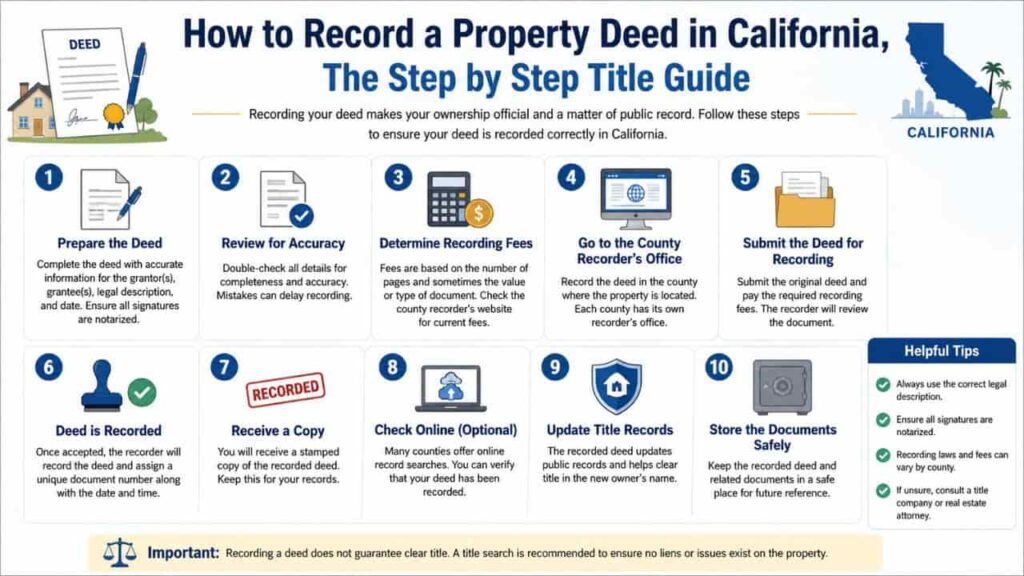
Step by Step Guide to the California Deed Recording Process
To ensure your document is successfully indexed and to prevent costly title rejections, you must execute the process sequentially.
1 (Prerequisite Phase). Document Preparation and Statutory Formatting
Draft your chosen document using standard California legal templates. The first page must reserve a blank 2 inch vertical margin at the top right to allow adequate space for the Recorder’s official digital entry stamp. All text must be clearly legible and printed in black ink to comply with digital scanning protocols.
2 (Verification Phase). Execute the Notary Acknowledgment
The grantor (the party relinquishing interest) must sign the document in the presence of a licensed Notary Public. California strictly mandates the inclusion of a specific statutory block text warning for all notary acknowledgments under California Civil Code Section 1189.
3 (Tax Compliance Phase). Complete the Preliminary Change of Ownership Report (PCOR)
Fill out Form BOE 502 A (PCOR) completely. This form provides the County Assessor with critical transaction data. Leaving fields blank or failing to attach this document results in an automatic $20 recording penalty fee and triggers immediate property tax reassessment investigations.
4 (Final Submission Phase). Calculate Fees and Formally File Document
Present the original document containing fresh “wet signatures” to the specific County Clerk Recorder office where the parcel physically resides. Submit the base recording fee along with the $75 Building Homes and Jobs Act (SB 2) fee, unless an explicit exemption applies.
Critical Tax Forms and Exemptions Explained
Property transfers in California instantly trigger tax audits under Proposition 13 guidelines. To prevent your document from being flagged for automatic, retroactive property tax reassessments, you must accurately declare tax exemptions at the moment of recording.
1. Preliminary Change of Ownership Report (PCOR)
The PCOR is a four page document required by all 58 county assessors. It asks whether the transfer is a market rate sale, a gift, or an internal transfer between family members. If you are transferring property into a revocable living trust or between spouses, you must note this explicitly on the PCOR to maintain your current Base Year Value assessment.
2. Documentary Transfer Tax (DTT)
Under California Revenue and Taxation Code Section 11911, a transfer tax is levied on real estate conveyances when the consideration (sale price or value) exceeds $100. The standard statewide rate is $0.55 per $500 of property value ($1.10 per $1,000).
- Note on Local Rules
Certain charter cities (like Los Angeles, San Francisco, and Oakland) impose their own heavy municipal transfer taxes in addition to the standard county rate. - Declaring an Exemption
If no money is changing hands (such as a gift or a transfer into a living trust), you must write a specific, legal Transfer Tax Exemption Statement directly onto the face of the deed before recording it (e.g., “Exempt from Documentary Transfer Tax under Revenue & Taxation Code Section 11925″).
Common Pitfalls That Lead to Recording Rejections
Even minor clerical errors can break your chain of title or result in a rejected document mailing weeks later. Watch out for these three technical traps.
- Missing Assessor’s Parcel Number (APN)
California law requires the property’s unique APN to be clearly typed on the first page of the deed. Without it, the Clerk Recorder cannot index the transaction against the proper county tax map location. - Incorrect Legal Description
The street address is not enough to secure a title change. The deed must contain the full, exact Legal Description of the land (including lot numbers, block mappings, and subdivision tract names) as listed on the property’s original preliminary title report. - Illegible Notary Seals
If the notary public stamps their official seal over your signature or text, making it unreadable, the scanning software will reject the file. Ensure the notary seal is placed in a clean, blank boundary box.
Conclusion
Recording a California property deed requires absolute adherence to structural formatting rules, notary acknowledgments, and essential tax filings like the PCOR. By carefully working through the requirements of county clerk recorders and identifying applicable transfer tax exemptions, you protect your chain of title while ensuring full compliance with Proposition 13 guidelines.
FAQs
What is the fee to record a property deed in California?
Base recording fees are usually $14 for the first page and $3 per additional page, plus a mandatory $75 Building Homes and Jobs Act (SB 2) fee unless exempt.
Can I record a property deed in California without a PCOR?
Yes, but the County Recorder will charge an automatic $20 penalty fee, and the Assessor may immediately launch an aggressive property tax reassessment investigation against your parcel.
What is the standard Documentary Transfer Tax rate in California?
The statewide county rate is $0.55 per $500 of property value. However, specific charter cities like Los Angeles or San Francisco impose additional, much higher municipal transfer taxes.
How do I claim a transfer tax exemption on a California deed?
You must type a formal legal exemption statement directly onto the front page of the deed, citing the specific California Revenue and Taxation Code section before submitting it.
Does transferring property into a living trust trigger a tax reassessment?
No. Under Proposition 19 guidelines, transferring a real estate title into a revocable living trust is an exempt transaction that preserves your property’s original base year valuation.
Where do I physically go to record a real estate deed?
You must submit the document to the official County Clerk Recorder’s office in the specific county where the real estate parcel is geographically located.
What happens if my California deed has an incorrect legal description?
The recording may be rejected, or worse, it will create a major cloud on the title, making it impossible to legally sell or refinance the property later.