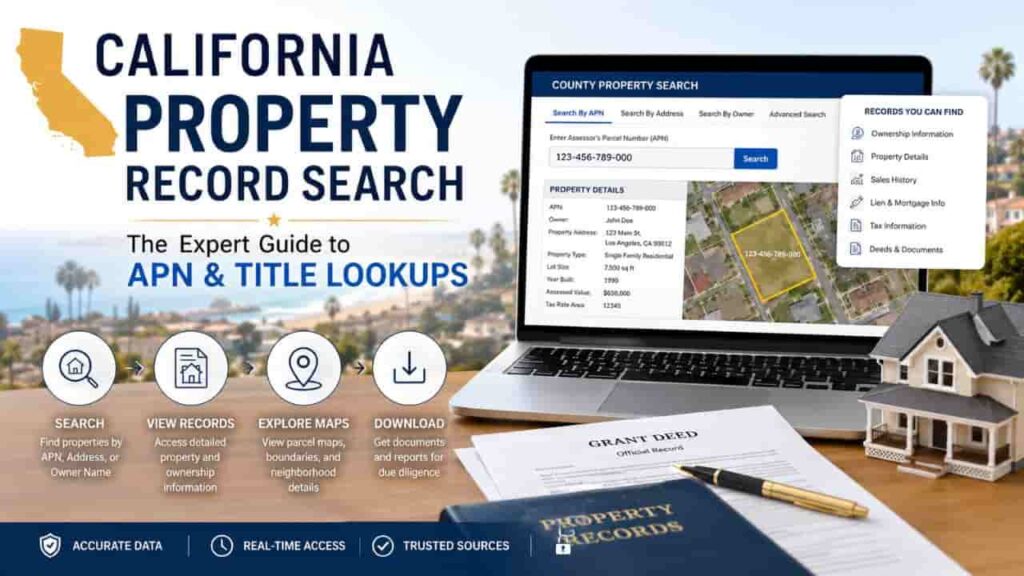
The California’s real estate data structure can be challenging for investors, home buyers, and researchers alike. Unlike states with centralized data repositories, the Golden State processes property records through a decentralized system split across 58 individual counties. To execute a successful property search, you must understand how the County Assessor and the County Clerk Recorder divide their duties, and how to utilize an Assessor’s Parcel Number (APN) to unlock structural, financial, and legal ownership details. This comprehensive guide provides step-by-step methods to access authentic California public records while ensuring full compliance with state property codes.
The Foundation of California Property Records: Assessor vs. Recorder
To find authentic property information, you must query the correct government entity. Many researchers waste hours looking for ownership deeds in the Assessor’s office or property tax values at the Recorder’s desk.
The County Assessor
The County Assessor’s primary mandate under the California Revenue and Taxation Code is to locate all taxable property within the county and establish its assessed value.
- What you find here: Assessor’s Parcel Maps, building characteristics (square footage, bedrooms, year built), property tax exemptions (e.g., Homeowners’ Exemption), and the current assessed value.
- Primary Search Identifier: Assessor’s Parcel Number (APN).
The County Clerk Recorder
The County Clerk Recorder maintains the official public repository for legally binding land documents. This office records documents that affect property titles, liens, and encumbrances.
- What you find here: Grant Deeds, Deeds of Trust, Grantor/Grantee Indexes, federal tax liens, mechanics liens, and easement agreements.
- Primary Search Identifier: Document Number, Book and Page Number, or Owner Name.
Decoding the California Assessor’s Parcel Number (APN)
The Assessor’s Parcel Number is a unique string of numbers assigned to every individual piece of real estate in California. Rather than a random sequence, the APN is a spatial coordinate system that tells you exactly where the property sits on an official tax map.
Most California counties utilize an 8 digit or 9 digit format, typically written with hyphens: Triple-Double-Triple (000-00-000).
Anatomy of a California APN
| APN Segment | Technical Component | Property Record Function |
First 3 Digits (e.g., 123) | Map Book Number | Identifies the specific, large-scale geographical book volume maintained by the county assessor covering a particular neighborhood or district. |
Middle 2-3 Digits (e.g., 45) | Page and Block Number | Pinpoints the precise page within that map book, and often the specific subdivision block where the property resides. |
Final 3 Digits (e.g., 678) | Parcel Number | Represents the specific lot number assigned to that individual piece of land on the assessor’s page. |
Understanding this structural format allows you to easily decipher county plat maps and quickly identify adjacent parcels when evaluating local zoning and boundary lines.
Step by Step Guide to Performing a Property Search in California
Follow these official steps to pull public records accurately without paying premium fees to unauthorized third party scraping sites.
Step 1: Locate the Property Address or Boundary Data
Before launching an online query, secure the exact street address. If you are researching vacant land without an assigned street number, you will need to utilize the county’s interactive GIS (Geographic Information System) map to visually click on the parcel and retrieve its assigned APN.
Step 2: Query the County Assessor for Property Characteristics
- Visit the official website of the specific county where the property is located (e.g., Los Angeles County Assessor, Orange County Assessor). Ensure the web domain ends in
.govor.org. - Locate the “Property Assessment Information System” or “APN Portal.”
- Input the street address or APN.
- Review the structural data. This screen will display the current assessed Base Year Value under California Proposition 13 guidelines.
Step 3: Check for Supplemental Tax Liabilities
When ownership changes in California, a property is reassessed at its new market value. The new owner receives a separate Supplemental Tax Bill to cover the difference between the prior owner’s old assessment and the new purchase price.
- Navigate to the County Tax Collector’s portal.
- Input the APN to verify if there are any outstanding secured taxes, delinquent balances, or pending supplemental assessments that could result in a tax lien.
Step 4: Trace Title History via the Grantor/Grantee Index
To confirm legal ownership, view chain of title, or check for liens, you must cross-reference the data with the County Recorder.
- Access the online Public Index portal for the County Recorder.
- Search by the owner’s legal name using the Grantor/Grantee Index (The Grantor is the seller/transferor; the Grantee is the buyer/recipient).
- Identify the most recently recorded Grant Deed or Interspousal Transfer Deed to verify ownership validity.
- Note the official Document Number (e.g., Doc # 2026-1234567) if you need to order a certified copy.
Critical California Statutes Impacting Property Data Access
When extracting public records in California, several state laws govern data availability, property valuations, and privacy protections.
- Proposition 13 (1978):
Limits property tax rates to 1% of the property’s assessed value. It mandates that a property’s assessed value cannot increase by more than 2% per year unless there is a change in ownership or major new construction. - California Government Code Section 6254.21:
Protects the privacy of elected or appointed officials (including judges and law enforcement officers). Counties are legally required to redact or restrict online search capabilities for these individuals’ primary residential addresses. If a property is protected under this statute, its ownership details will not show up via online address queries. - Preliminary Change of Ownership Report (PCOR):
Under California Revenue and Taxation Code Section 480, whenever a deed is filed with the Recorder, a completed PCOR form must accompany it. This document signals the Assessor to review the transaction value for tax adjustment.
Troubleshooting Common California Property Search Issues
- The Address Cannot Be Found: If an address returns zero results on an Assessor’s portal, the property might be a new subdivision lot where the address has not yet been synced to the tax roll. Use the county’s GIS map tool to locate the parcel visually, or search using the tract and lot number from the original subdivision map.
- Ownership Name is Hidden: If the owner field displays a corporate entity, an LLC, or a family trust (e.g., “John Doe, Trustee”), the public record is working exactly as intended. To find the individuals behind an LLC, you must take the entity name found on the deed and run a business entity search through the California Secretary of State (SOS) portal.
- Inaccurate Square Footage: If the Assessor’s database lists a property as a 3-bedroom home, but it is marketed as a 4-bedroom home, unpermitted construction may have taken place. Unpermitted additions are not factored into the official public record until discovered by code enforcement or self-reported by the owner, which triggers a localized property tax reassessment.
Professional Disclaimer: This platform is an independent informational hub providing educational guides on public records access. It is not affiliated with, operated by, or endorsed by any California state, county, or municipal government authority. For official legal title opinions or formal tax determinations, consult a licensed real estate attorney, a certified title officer, or the local County Assessor’s office directly.
Conclusion
Mastering California property record searches requires a precise understanding of the division between County Assessors and Clerk Recorders. By leveraging the spatial coordinates embedded within an Assessor’s Parcel Number (APN) and navigating the Grantor/Grantee index, you can uncover authentic ownership data, structural characteristics, and title histories. Amid complex statutes like Proposition 13 and strict privacy redactions, utilizing official county channels ensures maximum accuracy. Whether evaluating local property tax liabilities or conducting investment due diligence, utilizing this step by step methodology guarantees reliable, compliant, and actionable real estate intelligence.
FAQs
How do I perform a free California property ownership search by address?
Visit the official County Assessor’s website. Input the street address into their portal to view public structural data, tax valuations, and the parcel number completely free of charge.
What is the difference between a California Grant Deed and a Quitclaim Deed?
A Grant Deed guarantees the seller owns the property free of undisclosed encumbrances. A Quitclaim Deed transfers existing interest with no structural warranties or ownership protections.
Why did I receive a California supplemental tax bill after buying a house?
It covers the tax difference between the previous owner’s lower Proposition 13 assessment and your new, higher purchase price value from your closing date forward.
How do I look up real estate liens or encumbrances in California?
Search the County Clerk Recorder’s official Grantor/Grantee index online or in person using the owner’s full legal name to find recorded lien documents and financial encumbrances.
Why is the owner’s name hidden or redacted on a California property record search?
California Government Code 6254.21 protects public officials by redacting their names online. Alternatively, the property may be legally shielded under a private LLC or family trust.
Can I find property records through a centralized California state database?
No, California real estate data is completely decentralized. You must access records directly through the specific Assessor or Recorder office of the county where the property sits.
What should I do if the County Assessor’s property square footage is wrong?
Contact the local Office of the Assessor to request a correction review. Correcting errors or documenting unpermitted additions will trigger an updated property tax assessment.